wiki-assistant
Chat over a personal markdown wiki
An OpenWebUI ↔ OpenCode bridge for querying a personal markdown wiki with an LLM.
Deliberately no RAG and no embeddings: the model reads the actual files, orienting
itself from a root index.md (based on LLM Wiki idea).
OpenWebUI · OpenCode · Docker · LLM Wiki
Payment Reconciliation
Bank transfers matched to policies · Wide Group
An AI system that matches incoming bank transfers against customer insurance policies,
handling the messy free-text references humans put in payment descriptions. Reduced manual
reconciliation time by roughly 80%.
Python · scikit-learn · Kafka · PostgreSQL
siyuan-mcp
MCP server for the SiYuan note app
An MCP server that exposes a SiYuan knowledge base to LLM
clients such as Claude Code, down to individual notebooks, documents and blocks, so an
agent can read and write personal notes as a first-class tool rather than through
copy-paste.
Python · MCP · uv
Scraper Agents
Agentic data extraction at scale · Wide Group
A scalable scraping architecture built on AI agents and a custom MCP server. Agents handle
the parts that change: page structure, selectors, edge cases. The surrounding workflow
stays deterministic, so runs are reproducible and failures are debuggable instead of
mysterious.
Python · MCP · LangChain · Kafka · Docker
LLaVA / LLaVA-NeXT adapters
MSc thesis: multimodal adapters
Improved multimodal LLM performance using a C-abstractor adapter between the vision encoder
and the language model, trading a small amount of spatial detail for a large reduction in
visual token count.
PyTorch · Python · MLLM
NaviSync
Navidrome → phone music sync
Android app that mirrors an entire Navidrome library (or any
Subsonic-compatible server) into a local folder any player can read. Playlists export to
.m3u8 with relative paths, and starred tracks sync both ways.
Not rsync: Subsonic only speaks HTTP, so the sync is idempotent logic on top of the API,
index the server, diff against the folder, and pull only what is missing or changed via the
download endpoint, which returns the original file rather than a transcode.
Kotlin · Android · Subsonic API
muxlib
Self-hosted music library manager
Downloads YouTube audio as MP3, writes the metadata, and files it into a personal library.
Driven from a Telegram bot, so adding a track is one message from a phone: send a link and
it is either delivered back as a file or saved straight to the server, depending on who is
asking.
Python · yt-dlp · Telegram Bot API
Homelab
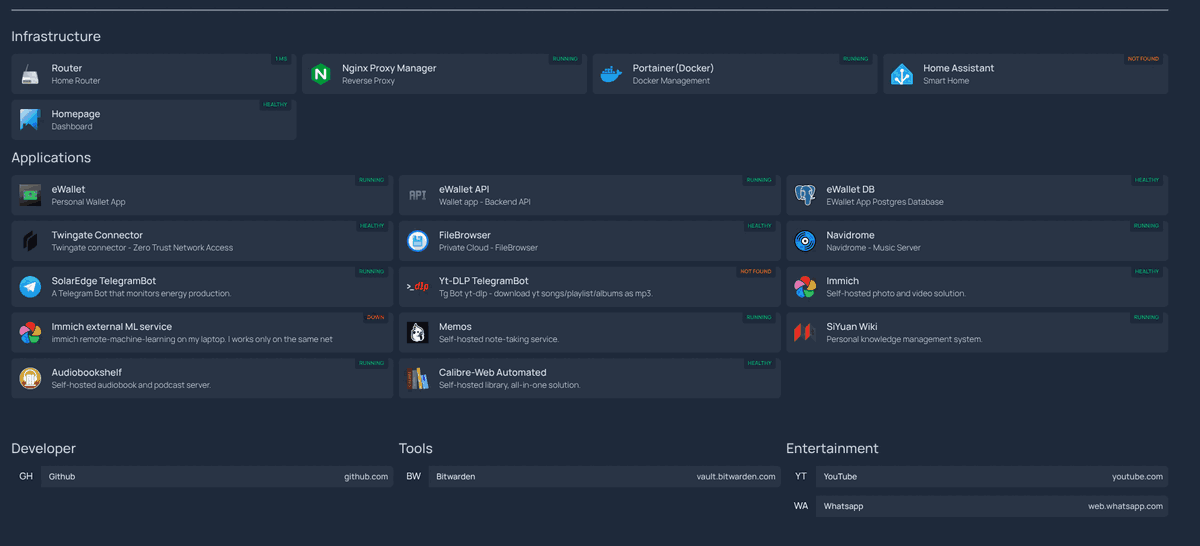
Self-hosted everything, across two houses
Two machines, in two different houses, running about twenty services behind a reverse
proxy and joined by a zero trust network rather than an open port. Photos, music,
audiobooks, ebooks, notes and files all live there rather than in someone else’s cloud, and
a dashboard tells me at a glance what is healthy and what is not.
Part of it is stuff I wrote: a personal wallet app with its own API and Postgres database,
a Telegram bot that reports how much the solar panels are producing, and a few smaller
things that exist only because it was quicker to build them than to look for them.
It is also where anything new gets tried first. If a tool survives a few weeks of me
actually depending on it, it stays.
Docker · Linux · Nginx Proxy Manager · Twingate · PostgreSQL
Earlier projects
University and side work
- Smart Library: distributed system for fully autonomous, delocalised book lending
across automated totems. IoT hardware, the architecture around it, and the loan logic.
- Best Client: Android app that surfaces a customer’s rating while the phone is
ringing, so restaurateurs know who is calling. Published on the Play Store.
- Colors Zone: real-time COVID-19 restriction zone for any Italian region, with the
rules attached to each colour.
- Actor Detector: automatic detection and recognition of the actors present in a movie
scene.
- ML Algorithms: classification, regression, clustering, dimensionality reduction and
ensembles, plus model selection and evaluation.
Java · Android · JavaScript · Python